
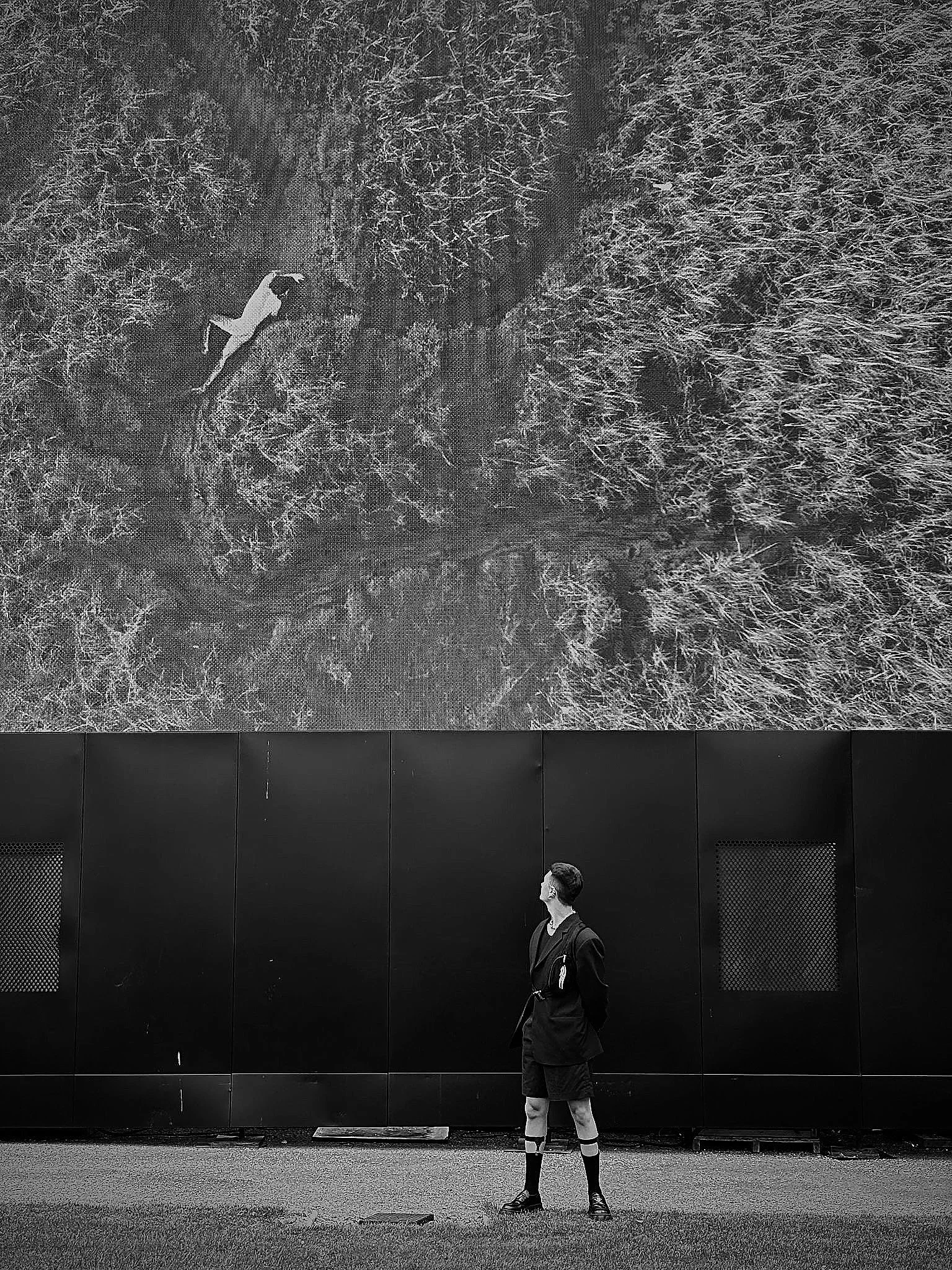








Body Signal as part of Living Canvas, Irish Museum of Modern Art, 2025
Body Signal is a performance-based film that explores the entanglement between the human body, landscape, and surveillance technology. Captured from an aerial perspective by a drone, the film follows the body as it crawls through a meandering wetland, exposing the traces left behind through movement and intervention. The work draws attention to how both bodies and landscapes are subjected to observation and control, raising questions about agency, visibility, and the impact of technology on lived experience.
Through its slow, aimless movement, the body appears lost, searching for direction in an uncertain and shifting terrain, evoking a sense of disorientation in a world where human and nonhuman forces collide. The wetland becomes both a site of passage and a record of impact, underscoring the fragile relationship between presence and disappearance. The film asks how bodies navigate an era of ecological collapse and perpetual surveillance, highlighting the paradox of hyper-visibility in a time of both environmental and personal precarity.
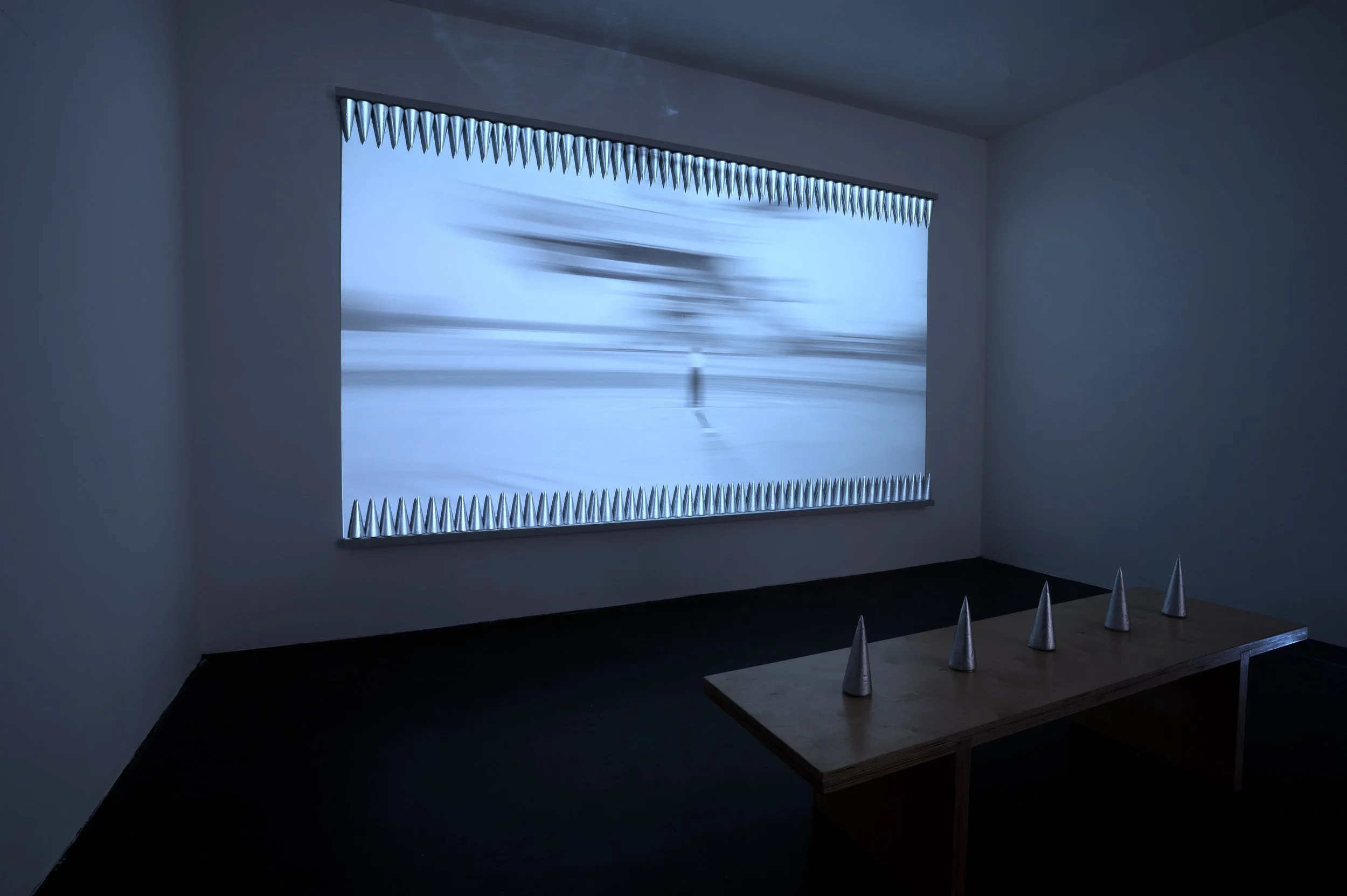
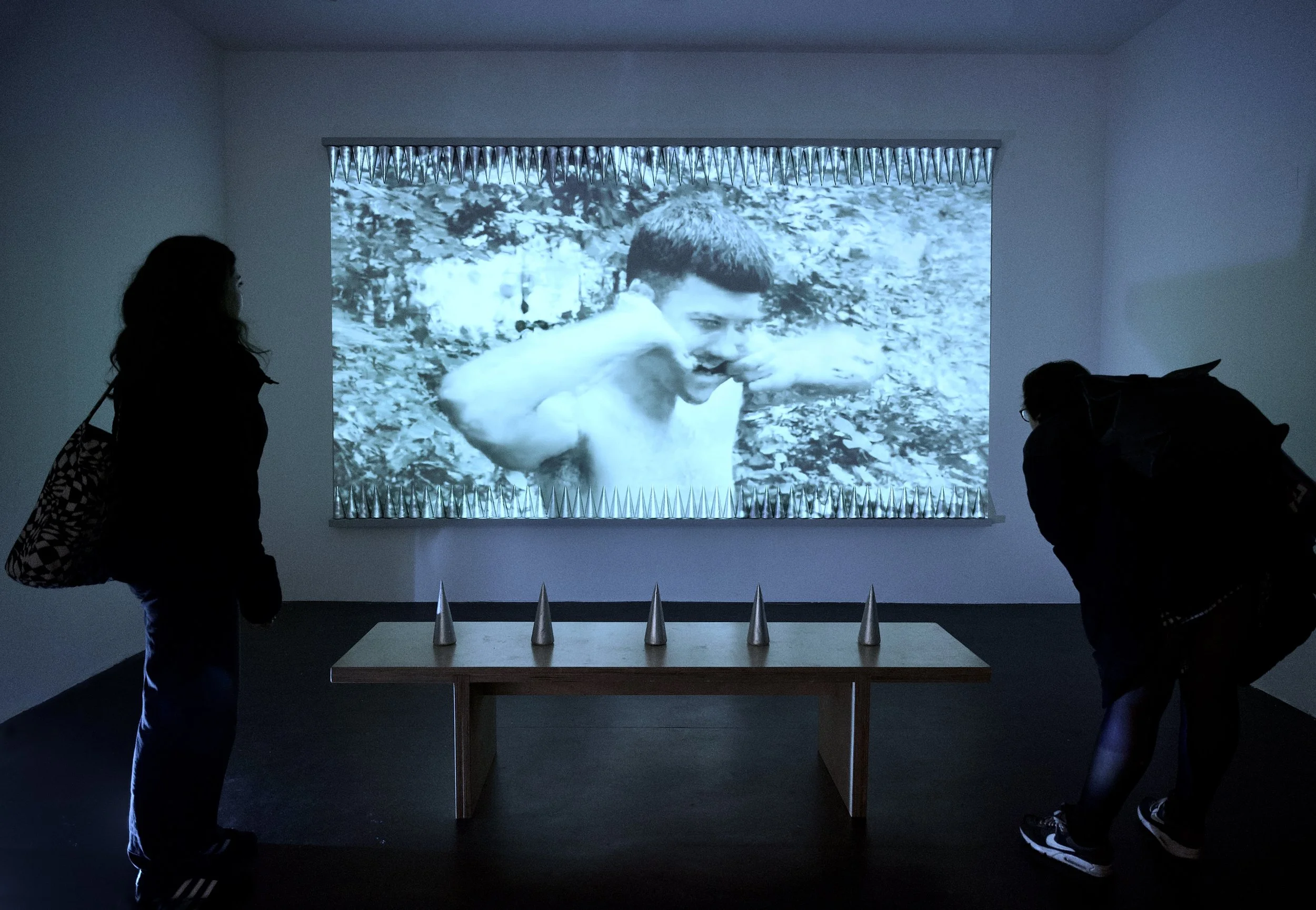
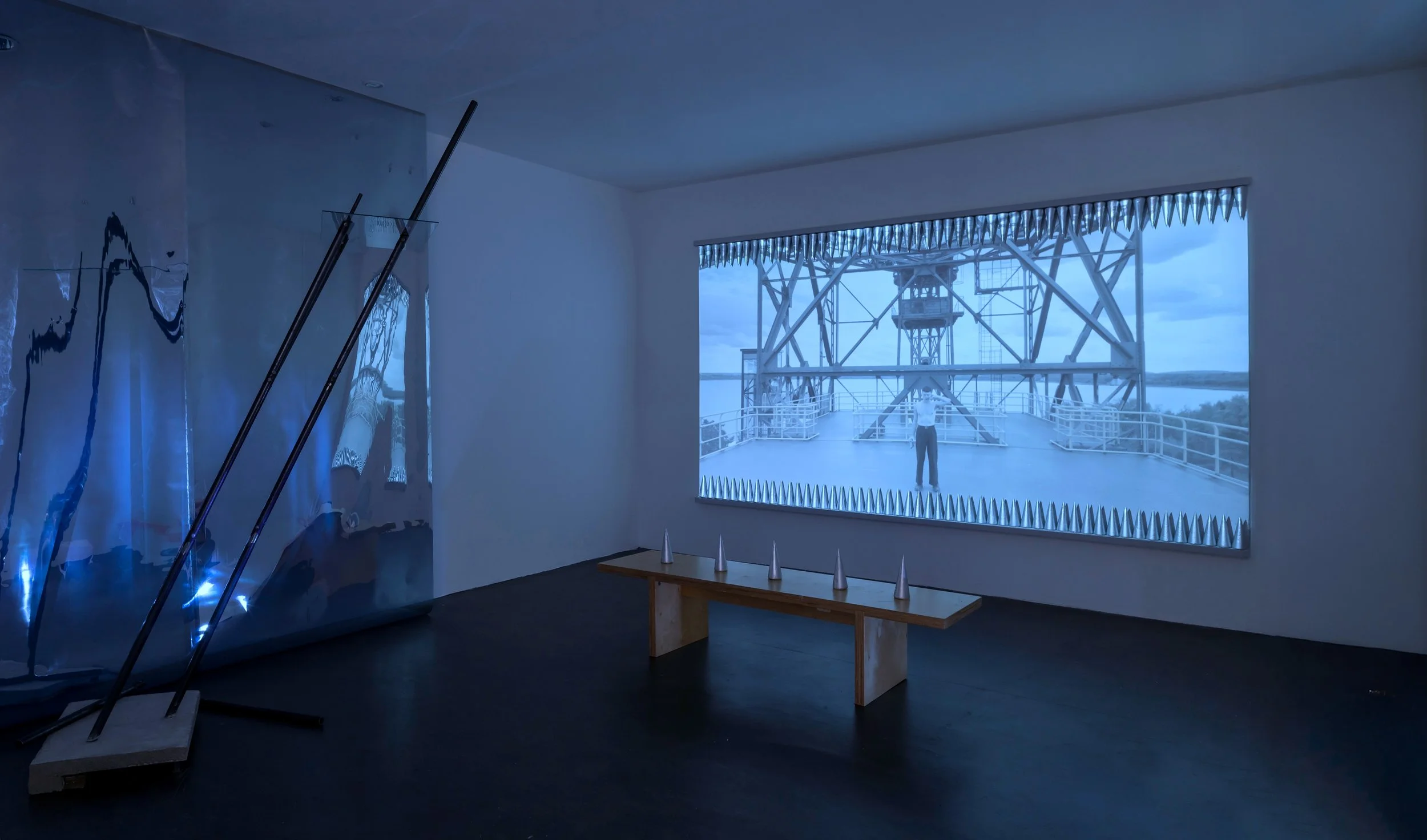
Auto-cannibalism II as part of Liquid Urbanism, The Lab Gallery, 2025
Auto-cannibalism II continues the exploration of self-exploitation under contemporary capitalism, extending the concept into the material and spatial dimensions of the gallery environment. The installation reframes the body as both producer and consumer within systemic pressures, while emphasising how external infrastructures enforce, regulate, and intensify these processes.
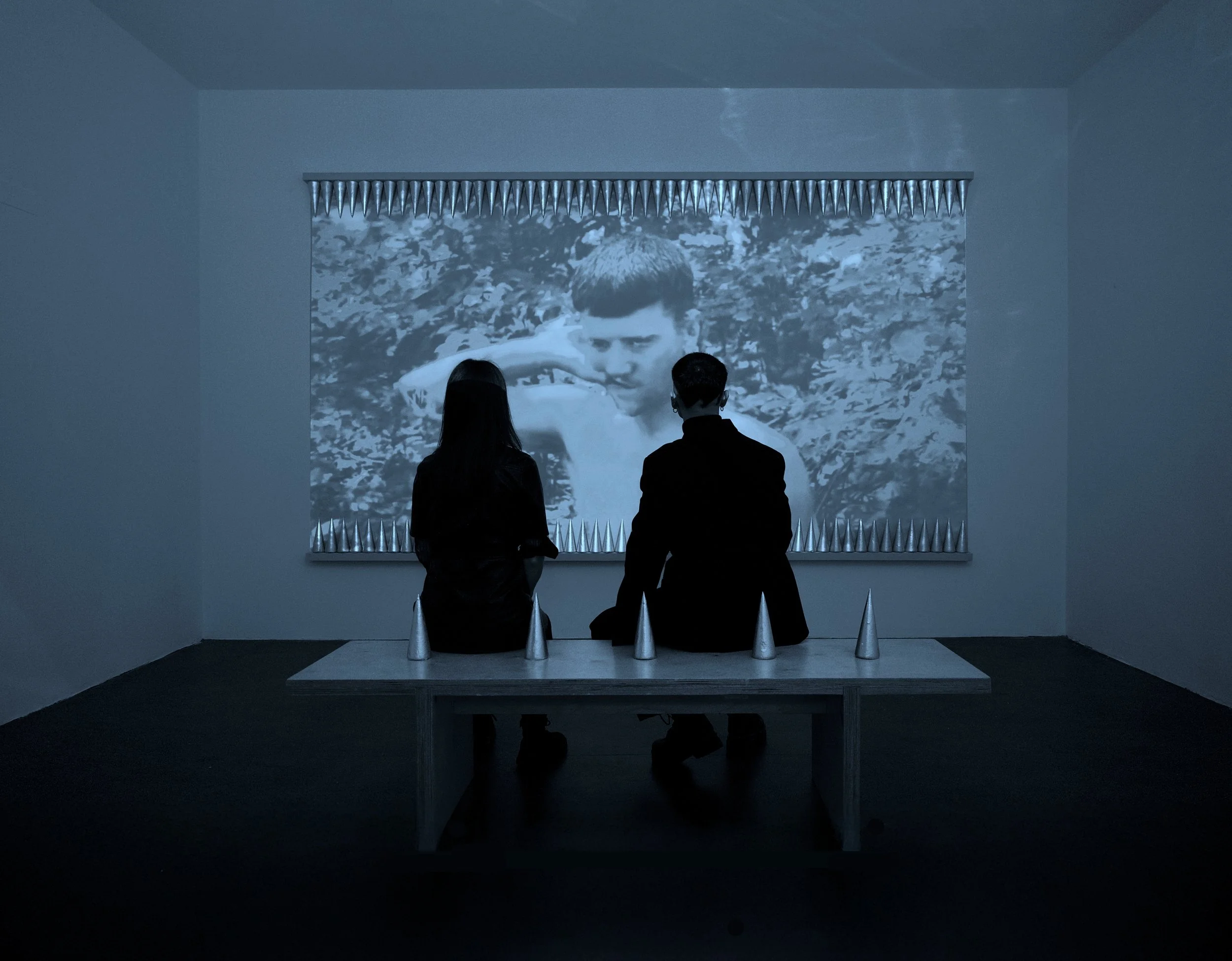
The film, marked by visceral and unsettling imagery, is framed by two rows of spikes above and below the screen, evoking a mouth and reflecting the devouring logic of hostile architecture. This sculptural element mirrors the way urban design can dismantle care and democracy, controlling bodies and limiting access. A reimagined gallery bench, incorporating the same spike motif, functions both as a functional object and a confrontational intervention, inviting viewers to negotiate engagement and discomfort.
By foregrounding the interaction between audience and environment, the work emphasises the physical and psychological dimensions of regulation and restriction. Viewers encounter spaces that are both enticing and threatening, provoking reflection on the structural forces embedded in public and private architecture. Through this interplay of film, sculpture, and audience participation, Auto-cannibalism II interrogates how capitalist systems extend beyond economic and social pressures to shape the very spaces and objects that govern everyday life.
What Was Lost as part of ⌥ERTIGO, A Crescendo, Cork County Council, 2025
What Was Lost interrogates the entanglements of techno-capitalist structures and bodily presence through performative, cinematic, and spatial interventions. The two-channel video installation envelops the audience in a sensorial environment where material, image, and body converge, engaging with the spectral traces of The Gearagh while gesturing toward speculative futures beyond extractive capitalism.
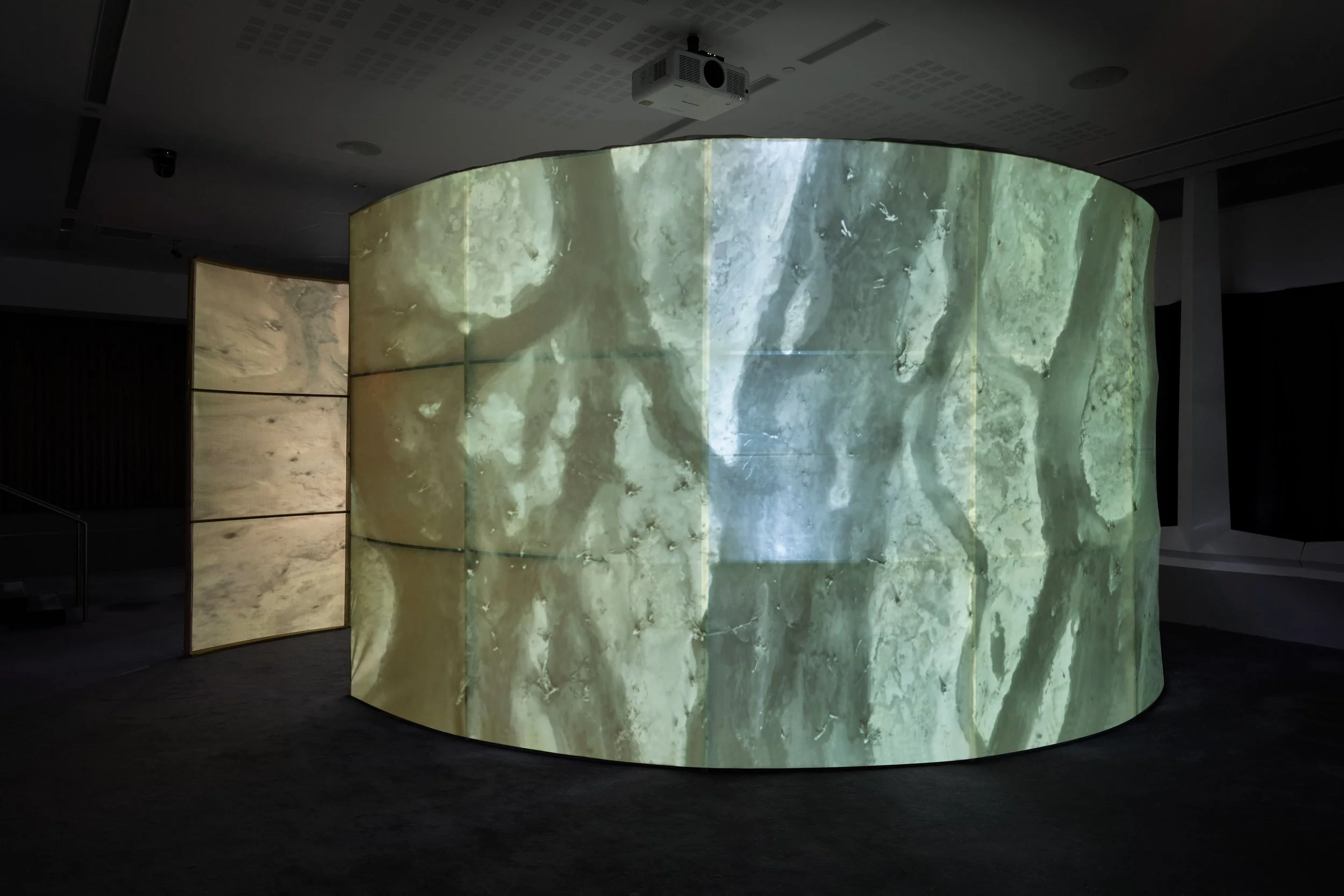
Projected onto curved latex screens, the film creates a visceral interplay between constraint, vulnerability, and disorientation. With its skin-like tactility, latex serves as both boundary and portal, mirroring the porous relationship between the human form and landscapes shaped by transformation and exploitation.
The film is set across two sites: The Gearagh, once a vast glacial woodland now drowned by the Inniscarra hydroelectric dam, and the dam itself, a monument to industrial progress and extractive capitalism. Each screen confronts the other, placing the technological advancements of the dam against the ecological loss of The Gearagh. The act of balancing on the skeletal remains of trees mirrors the instability of these ruptures, while the dam looms as both a source of power and a symbol of destruction.
By situating the queer body within this precarious terrain, the work models political imagination as a mode of thinking, sensing, and seeing across time. It asks how we might engage with histories of loss, not as endpoints, but as openings for collective agency and ecological re-imagining.
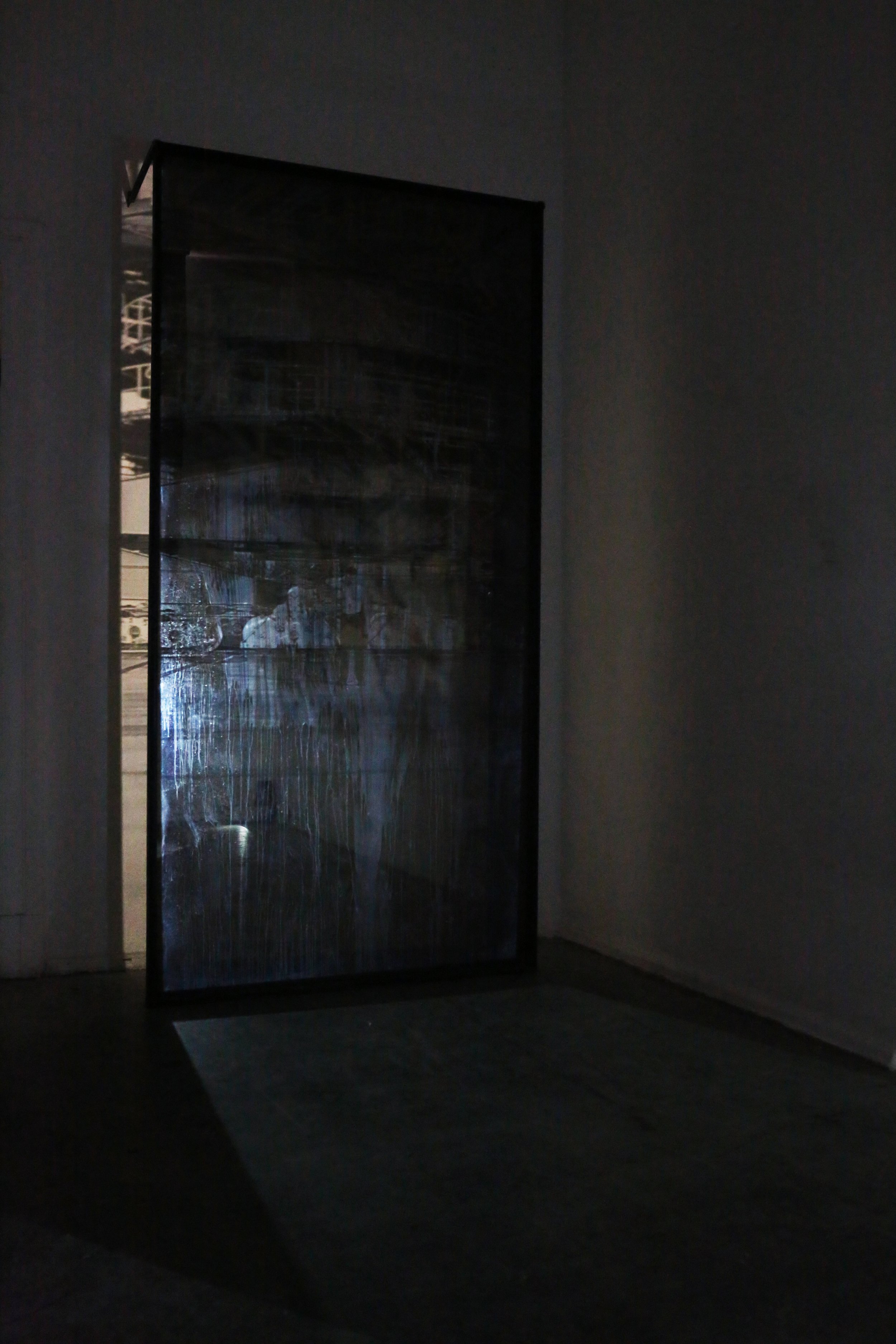
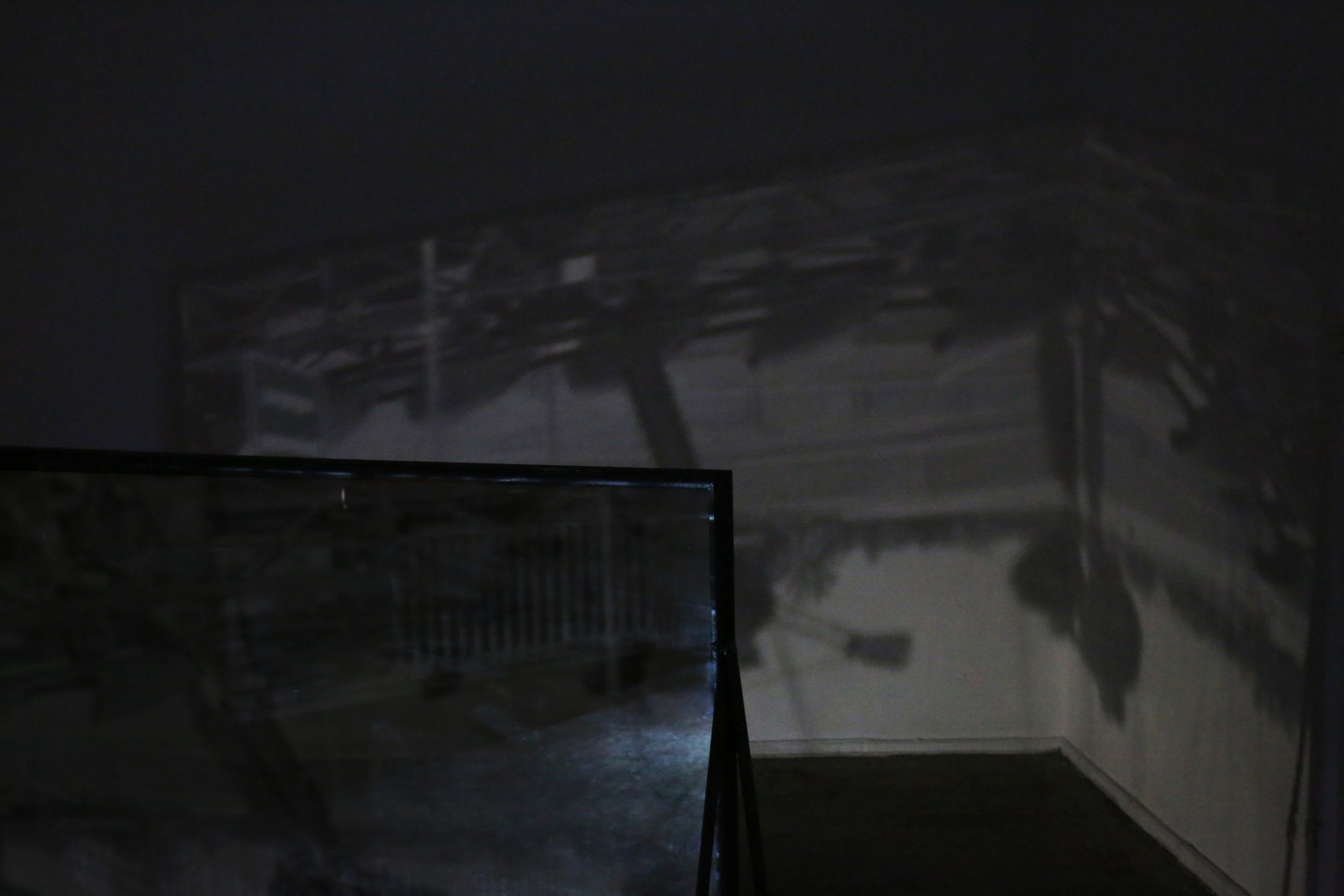
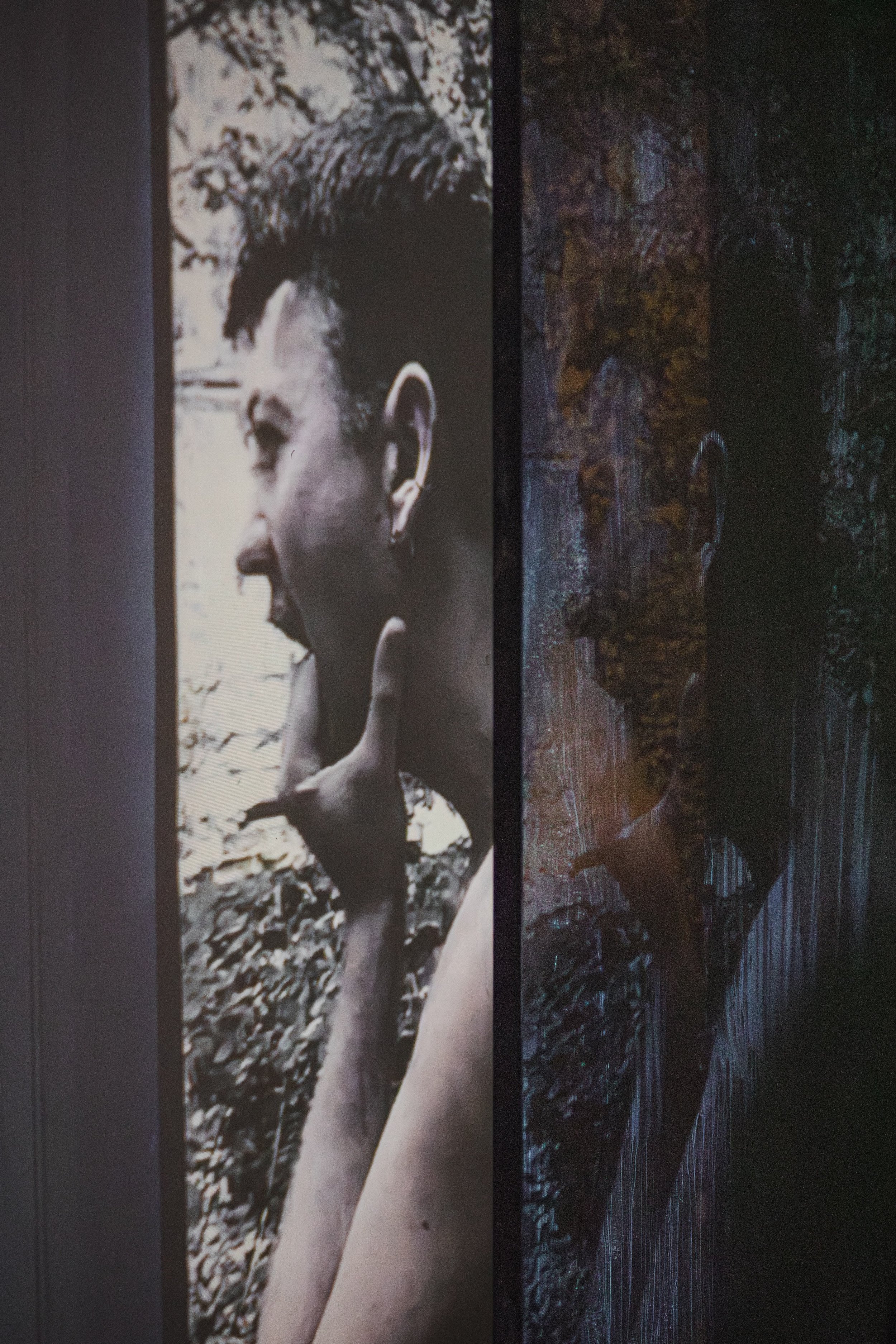
Auto-cannibalism as part of GlogauAIR, 2024
Auto-cannibalism is a provocative exploration of self-exploitation within contemporary capitalist systems, where the body becomes both a site of production and consumption. In this work, I address the psychological and physical toll of living in a neoliberal environment, using cannibalistic imagery as a metaphor for self-sacrifice and the erosion of individual identity in the pursuit of personal or societal goals. The term auto-cannibalism refers to the concept of self-destruction driven by forces such as economic pressures, technological advancements, and environmental degradation.
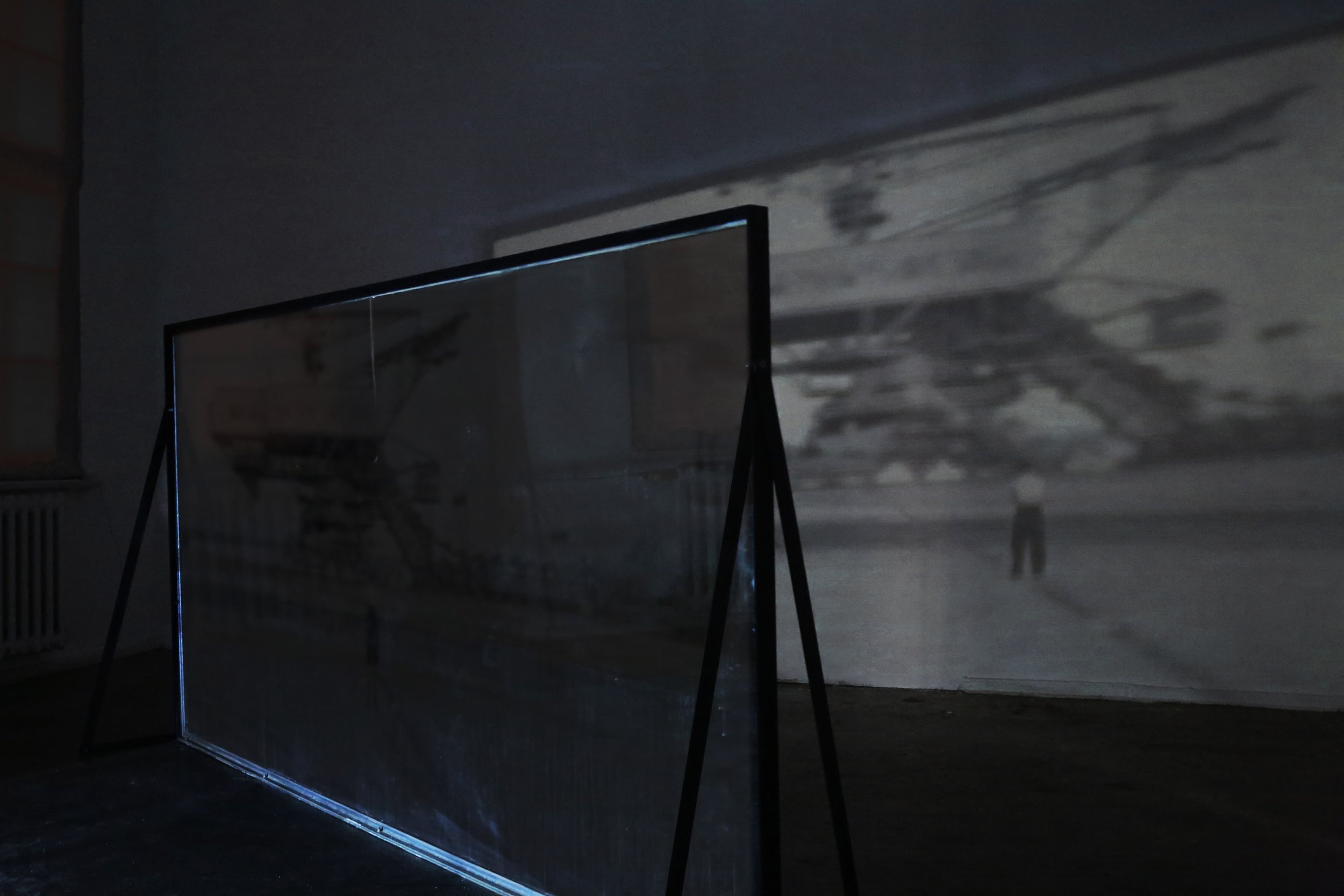
The installation projects the film onto two-way mirror, which creates an experience that implies surveillance. The mirror simultaneously reflects the viewer on one side and reveals a transparency on the other, suggesting a layered relationship between visibility and obscurity in capitalist systems. This duality implicates the viewer within the cycle of self-exploitation, as they see themselves both within the artwork and reflected back, signalling their role as both participant and observer in these destructive systems.
In the film, the use of visceral, sometimes grotesque imagery depicts this process of self-devouring, where the act of violence embodies the idea of a system that perpetuates self-consumption. The film’s narrative and visual elements are meant to disturb and provoke, encouraging viewers to reflect on the destructive cycles of capitalism and how individuals, knowingly or unknowingly, contribute to their own erasure. The work critiques not only personal sacrifice but also the wider societal mechanisms that enable such behaviours, drawing a parallel between self-cannibalism and the capitalist model that consumes resources and people alike.
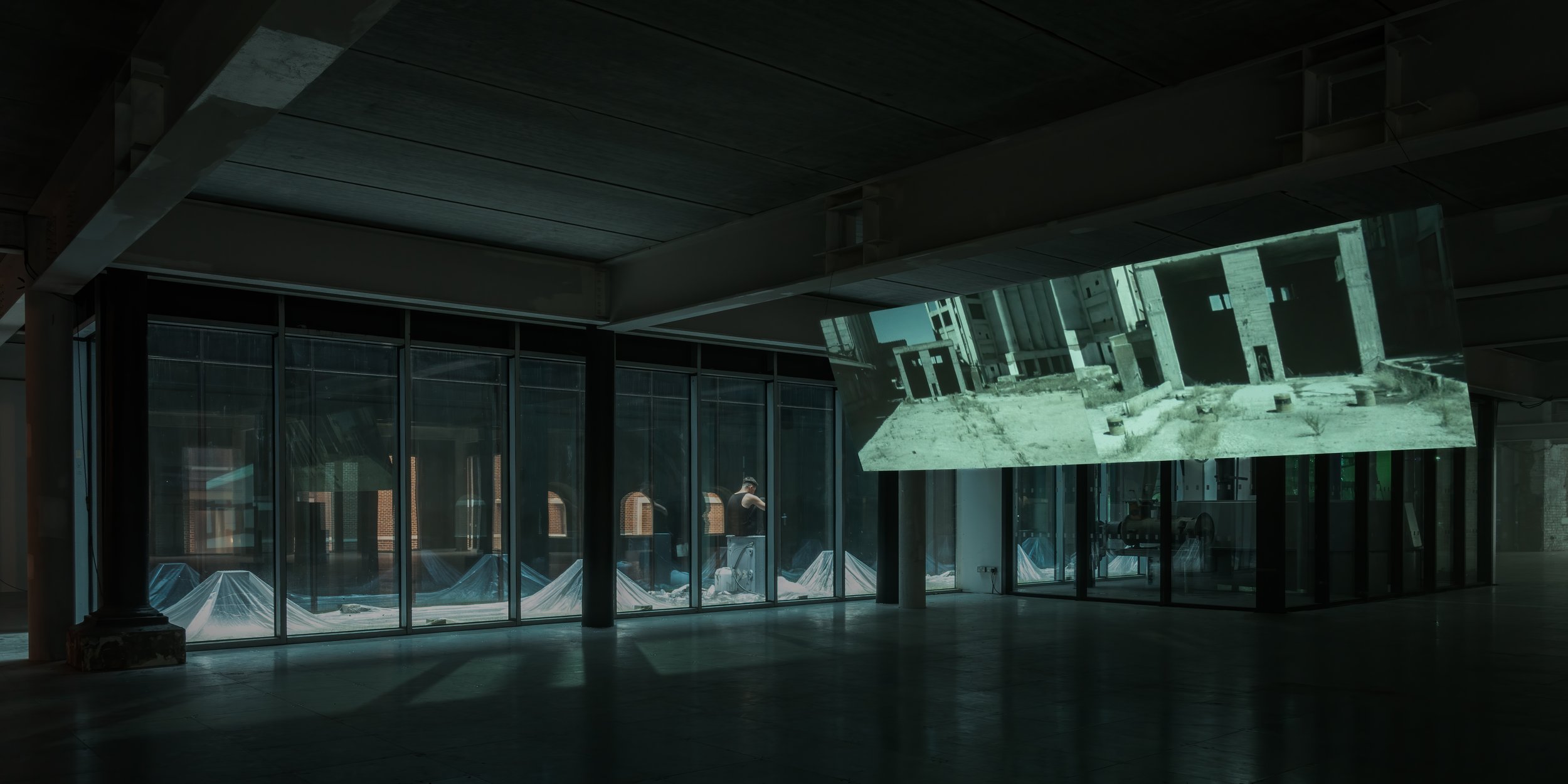
Machination as part of Oscillation: An Altering Rhythm, The Counting House, 2023
Machination is a multimedia installation examining mechanisation, surveillance, and control within contemporary capitalism. The work presents a speculative environment in which human agency is subsumed by machinery and technological systems, reflecting on automation’s psychological and corporeal effects. Its filmic elements, often stark and unsettling, explore how invisible structures of power, both technological and economic, mediate everyday life, highlighting the tension between autonomy and systemic control.
Central to the exhibition are site-specific live performances and audiovisual interventions that expand these themes through embodied and material experimentation. In Automation, the body is positioned atop a violently accelerating washing machine, which emits black, foamy liquid. The appliance functions as both an externalised stomach and mouth, processing and rejecting toxic systems. Sound sensors attached to the washing machine captured its vibrations, which were then reverberated throughout the space, amplifying the mechanised force and creating an immersive, multi-sensory environment. The black liquid symbolises the lies, pressures, and exploitative mechanisms of capitalist production that can no longer be digested. The performance dramatises the struggle to maintain composure amid structural instability, turning machinery into an active participant in negotiating human endurance and mechanised control.
Panopticism, a second site-specific performance, interrogates the dynamics of observation and control, inspired by Michel Foucault’s concept of the panopticon. The performer is elevated atop industrial equipment, enclosed within a transparent glass box. This configuration establishes simultaneous visibility and confinement, emphasising the tension between observer and observed. Slow, animalistic movements disrupt the clinical, mechanised environment, introducing instinctual energy that resists standardisation and dehumanisation. The contrast between bodily unpredictability and industrial precision critiques capitalist structures while revealing the potential for resistance, vitality, and autonomy within controlled systems.
Through the integration of performance, film, installation, sound, and sensor-driven interactions, Machination constructs a layered, interdisciplinary investigation into the intersections of technology, capital, and corporeality. The work challenges viewers to confront how mechanisation, surveillance, and systemic forces shape experience, while simultaneously exposing the capacity of the body and material environment to resist, recalibrate, and assert agency within these structures.
Tracing A Futureless Present as part of After Light: These Dark Citizens, R&H Hall, 2022
Tracing a Futureless Presentis an outdoor LED installation and durational performance that investigates urban nocturnality, infrastructural change, and the persistence of unrealised ambitions. Developed in collaboration with Peter Power, the work engaged audiences through a self-guided audio tour by night, revealing forgotten spaces, hidden histories, and the voices of the city’s nocturnal inhabitants. Sound, light, and visual elements created an immersive environment where participants could navigate the interweaving of past, present, and speculative futures.
Central to the work are performance videos and live actions staged within the now-demolished brutalist R&H Hall, one of Cork’s last remaining examples of its kind. These recordings and interventions feature the body dragging decommissioned streetlamp heads across the concrete landscape, and casting a large fishing net across the space. Together, these gestures reflect the labour of sustaining hope, the selective illumination of possibility, and the strain of carrying unrealised aspirations across post-industrial environments. The LED visuals, in dialogue with the live performance, amplify these themes, creating a layered interplay between presence, movement, and mediated light.
R&H Hall’s stark architecture, once emblematic of industrial strength, now abandoned, serves as both stage and material metaphor. The performance enacts the weight of industrial legacy and civic infrastructure, highlighting cycles of creation, decay, and obsolescence. Through the convergence of performance, moving image, sound, and light, the work constructs a fragmented, dystopian environment, evoking a temporal dislocation in which progress feels suspended, hope is unevenly distributed, and structures of power persist as inert yet enduring frameworks.
Strange Simultaneity as part of Oileán on view at the Battery Observatory Point, Spike Island, 2021
Strange Simultaneity is a site-responsive multimedia installation that explores temporal collapse, stalled futures, and the persistence of systems that outlive those subjected to them. Informed by Mark Fisher’s writing on hauntology, the work engages with the spectral coexistence of past, present, and future, where unrealised possibilities linger as an atmospheric condition rather than a fixed historical narrative.
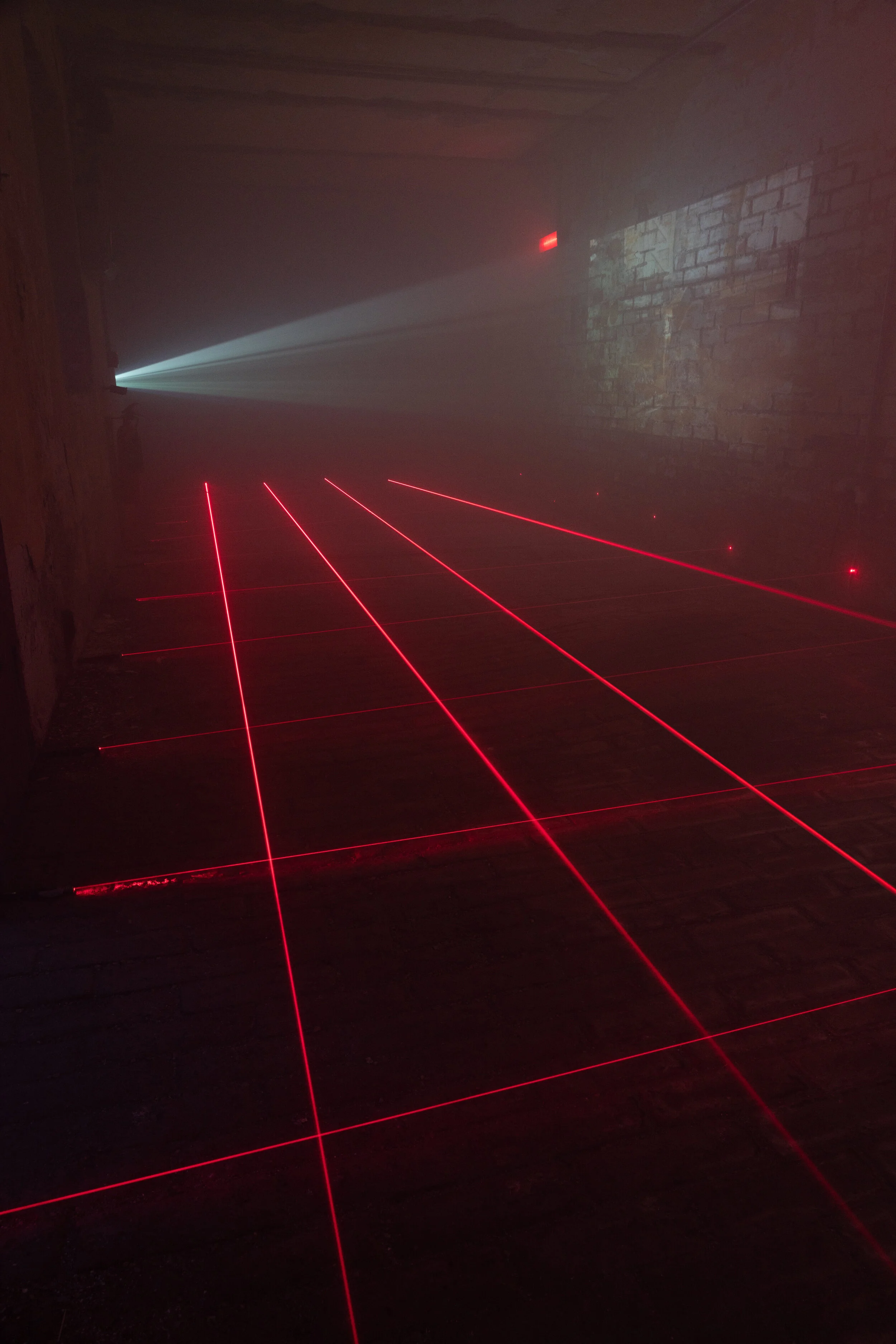
Installed within the Battery Observatory Point on Spike Island, the work draws on the site’s histories of containment, surveillance, and minor incarceration. Sound, laser floor gridding, and projected imagery produce a disorienting environment in which linear time is destabilised. The installation operates as a space where historical residue and speculative futures overlap, confronting the viewer with a sense of suspension, caught between what has been, what might have been, and what continues to repeat.
At the centre of the work is a performance video in which the body is laid horizontally atop a telecommunications tower, resembling a raised, post-industrial coffin. The tower functions as both infrastructure and metaphor: an infinite ladder that promises progress yet delivers stasis. Filmed as a durational action, the image reflects how capitalist systems perpetuate movement without transformation, advancement without arrival, embedding themselves across historical and contemporary forms of control.
Through its convergence of performance, moving image, sound, and spatial intervention, Strange Simultaneity amplifies a feeling of temporal dislocation and cultural inertia. The work reflects a present haunted by unresolved pasts and foreclosed futures, where technological acceleration and ecological collapse accumulate without offering clear paths forward, only the sensation of existing within systems that continue to reproduce themselves.
The Engineering of Consent II on view at The Marina Warehouse, 2021
The Engineering of Consent II extends and intensifies the concerns of the earlier body of work, shifting focus toward materiality, environment, and sensorial orchestration as mechanisms through which power is normalised and sustained. The exhibition operates as a total environment in which performance, moving image, industrial objects, sound, and atmosphere collectively shape how the body, both performed and viewing, is positioned within systems of control.
At the centre of the exhibition is the performance video No One’s Land. Filmed using drone-tracking technology, the work follows a solitary figure walking endlessly along a road within a post-industrial landscape. While the path offers multiple junctions and potential deviations, the body continues forward, fixed on the horizon. The movement is indefinite, repetitive, and unresolved. The footage appears low-resolution, not as an aesthetic affectation but as a by-product of the site itself, its visibility degraded by the constant output of surrounding smokestacks and industrial emissions. The result is an image that oscillates between clarity and interference, mirroring systems that promise choice while enforcing linearity.
Surrounding the video, industrial materials function as both sculptural presence and ideological agents. An industrial claw grab is isolated within the space, enclosed within a green capsule of light, its form suspended between dormancy and threat. Resembling a mechanical arachnid, the claw suggests a latent capacity for capture, extraction, and restraint. Though inactive, its posture implies readiness, an instrument of control that does not require movement to exert authority.
Adjacent to this, a shipping container filled with dense coils of industrial wiring evokes a more distributed form of control. The cables fold and loop across themselves in a manner that recalls serpentine movement, suggesting circulation, entanglement, and containment. Unlike the singular dominance of the claw, the wires operate collectively, referencing the hidden networks of energy, data, and logistics that underpin contemporary life. Together, these materials adopt almost animalistic characteristics, blurring distinctions between machine and organism and reinforcing the sense of an environment that is active, sentient, and regulating.
Metal drums are arranged within the space and filled with hydraulic oil, their surfaces treated as reflective planes. The oil creates a mirror-like sheen that implicates the viewer directly, folding their image into the work and collapsing distance between observer and system. The reflective surface asks the audience to confront their own position within cycles of production, consumption, and consent.
Smoke and sound are deployed to further destabilise orientation and perception, thickening the atmosphere and heightening sensory immersion. These elements do not function as background but as environmental forces that echo industrial processes themselves, obscuring vision, regulating movement, and shaping how bodies navigate space.
Together, the elements of The Engineering of Consent II operate in concert, exposing how agency is structured, deferred, and managed through repetition, infrastructure, and spectacle. The exhibition does not present power as overt force, but as an environment, one that is walked through, breathed in, reflected upon, and ultimately internalised.
The Engineering of Consent as part of COM,MA, No. 46 Grand Parade Gallery, 2020
The Engineering of Consent is a multimedia body of work examining power, influence, and the systems that shape public perception. Drawing on Noam Chomsky’s Manufacturing Consent, the work interrogates how media, technology, and industrial infrastructures produce and sustain public compliance in service of dominant economic and political interests.
Central to the work is the use of performance, film, installation, and sound, with live actions filmed using drone tracking technology. This aerial, machinic perspective establishes a systematised gaze that mirrors contemporary structures of surveillance and control, situating the human body within spatial and technological logics that exceed individual agency.
Across the performance video works Running Man, The Engineering of Consent, and Theatre of Suspension, the body is positioned within post-industrial environments as both subject and resource. In Running Man, the performer moves frantically through a post-industrial site with no visible point of escape, caught within the drone’s persistent gaze. While the imagery appears digitally augmented, evoking a game-like or simulated environment, the exerting body remains real, foregrounding endurance, repetition, and the illusion of progress within controlled systems.
In The Engineering of Consent, the body is laid upon the platform of a disused industrial oil tank station. Tubing suspended from the surrounding infrastructure connects directly to the performer’s mouth, suggesting a reciprocal yet unstable relationship between body and machine. The image oscillates between sustenance and dependency: the machine appears to fuel the body, while the body breathes life back into the system, exposing a power dynamic rooted in extraction, maintenance, and survival.
Theatre of Suspension presents the body dragged from an exposed trailer truck, restrained by industrial ratchet straps typically used to secure goods. Here, suspension operates both physically and metaphorically, reflecting the chaotic and performative nature of contemporary politics, where belief, truth, and stability are continuously staged, negotiated, and held in tension.
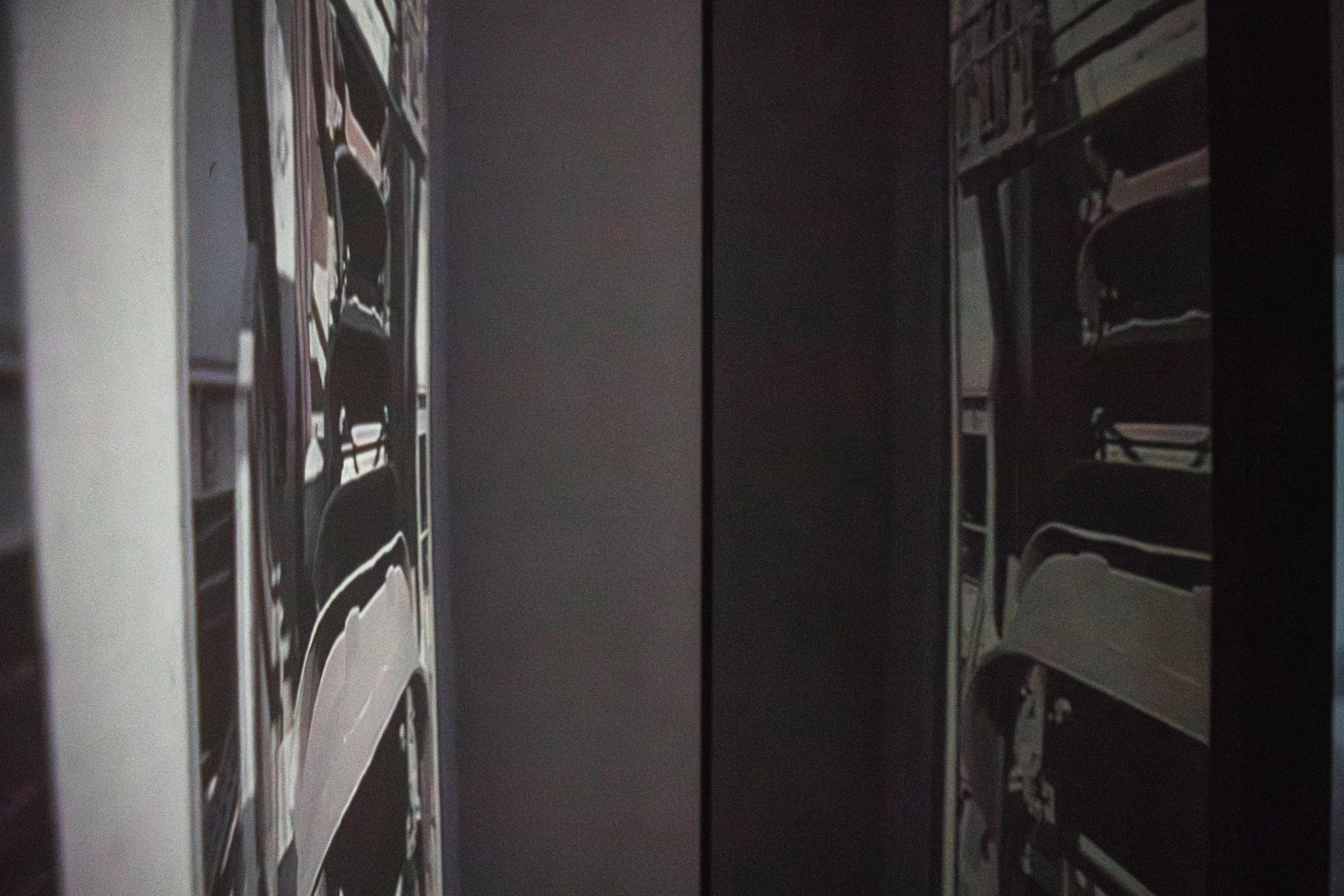
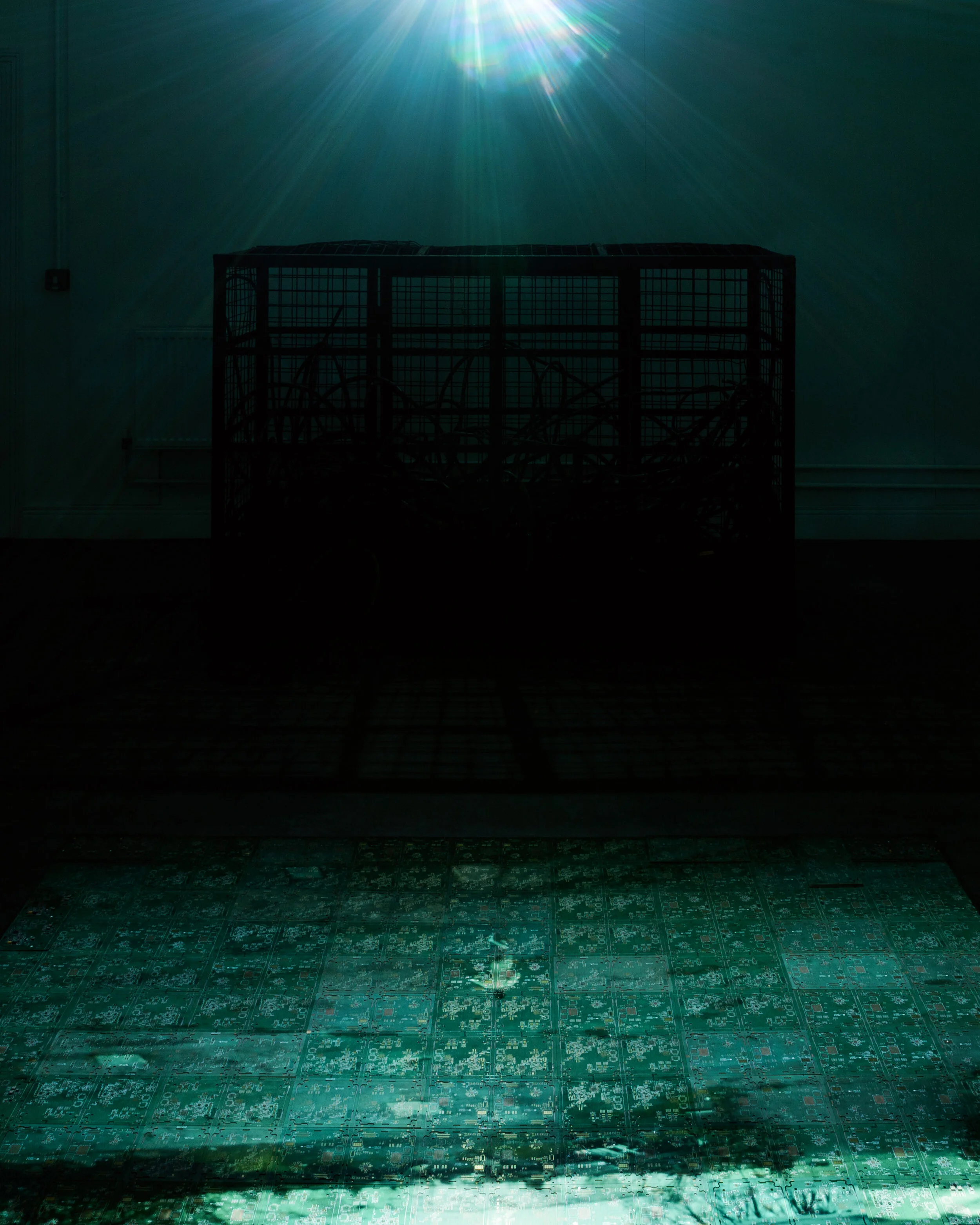
The recorded performances are subsequently projected onto exposed circuit boards, forming two modular screens that function simultaneously as image surface and technological object. By presenting the footage directly on technological infrastructure, the work foregrounds the material systems through which influence, information, and power circulate.
Together, these works examine the entanglement of embodiment, infrastructure, and ideology, positioning the body not as a site of resistance alone, but as one continually shaped, managed, and suspended within late-capitalist technological systems.
Caul as part of Confluence, Student of the Year, The Lavit Gallery, 2020
Caul as part of Dismantle, 2019
Caul is a deeply auto-fictional work that intricately weaves together personal history, themes of survival, and transformative ritual, while also addressing larger socio-political forces, particularly the pressures of technological advancements and patriarchal traditions.
The performance draws from my own birth experience, where the umbilical cord wrapped around my neck, causing a near-death experience. This life-or-death moment echoes the rites of passage in shamanic traditions, where such experiences are often seen as part of a spiritual or transformative journey. The auto-fictional nature of the work allows for narration into personal trauma within the framework of larger existential and societal forces, connecting physical survival to broader spiritual rituals that focus on transformation and rebirth. This aspect of the work speaks to the human need to reimagine or reset one’s connection to the world in the face of extreme circumstances, whether those are natural or societal.
Fall of Man expands upon these themes through a ritualistic and performative act that engages with the body’s vulnerabilities. Informed by contemplative practices, the work explores the possibility of temporarily stepping outside habitual patterns of thought. Standing beneath a waterfall, I subjected myself to extreme cold and pressure, creating a state of physical and sensory intensity that challenged the boundaries between endurance, consciousness, and embodiment. This act can be interpreted as a metaphorical shedding of imposed identities and external conditioning, allowing for a return to a more primal and unmediated relationship with the self. This moment of mental quiet contrasts with the increasing influence of technology, mechanised systems, and patriarchal structures that shape and regulate human experience.
The exhibition ultimately employs ritualistic acts of transformation as methods of resistance against alienating forces. Rather than seeking escape, these rituals create a space for reflection and self-preservation, allowing the body to regain agency within systems that increasingly demand conformity. Through these embodied performances, I explore the body as a site of negotiation and resistance, reimagining possibilities for human experience in the face of technological acceleration and inherited structures of power.